- Dari Kota Padang Sidempuan menuju Simaretong, masuk melalui Simarsayang (di PadangSidempuan), kita akan melewati puluhan Desa. Foto disamping adalah pemandangan kota PadangSidempuan dari Simarsayang. Simarsayang adalah nama tempat di Kota Padang Sidempuan, yang oleh pemerintahan kota dijadikan sebagai tempat wisata.
- Karakteristik dari Murai batu asal Padang Sidempuan bernama Penantian ini adalah : Volume kencang tajam melengking, dengan materi suara isian layaknya supermarket ada tembakan Cililin, Siri-Siri, Rambatan, Gereja tarung, Love Bird, Tengkek Buto, Srindit dan kasaran suara Balangkrek & Cucak Jenggot.
- **Suatu sketsa Kota Padang Sidempuan (klik foto jika ingin memperbesar gambar).Ini adalah suatu sketsa (analisis sederhana) berdasarkan fakta-fakta sejarah yang ada. Mungkin para generasi yang lebih muda tidak menyadari bahkan mungkin tidak mengetahui, bahwa Kota Padang Sidempuan masa kini, ternyata di jaman doeloe memiliki dinamikanya sendiri.
- Kota Padang Sidempuan terkenal dengan sebutan kota salak karena banyaknya kebun salak di sana, terutama pada kawasan di kaki Gunung Lubukraya. Nama kota ini berasal dari "Padang na dimpu" (padang=hamparan luas, na=di, dan dimpu=tinggi) yang berarti "hamparan rumput yang luas yang berada di temapat yang tinggi."
- Penduduk Padang Sidempuan pada tahun-tahun itu, sudah sangat maju secara social dan secara politik. Bahkan pada tahun 1919 di Padang Sidempuan sudah terbit surat kabar yang diberi nama Sinar Merdeka, surat kabar yang secara harpiah telah memberikan pencerahan bagi penduduk apa implikasinya imperialism dan apa manfaatnya independen (kemerdekaan).

- AlamatPanti.com - Di bawah ini ada daftar alamat panti asuhan di Padang, semoga bisa bermanfaat bagi yang membutuhan.. Panti Asuhan Aisyiyah. Jl Muara Penjalinan RT 001/01,Sarau Gadang,Nanggalo, Padang 25146 - Phone: 0751 481977


- Salak Sidempuan sudah terkenal dimana-mana dengan rasanya yang manis dan agak asam. Salak Sidempuan tumbuh mekar dan subur di sekitar pegunungan daerah Parsalakan yang tidak jauh dengan kota Padang Sidempuan. Salak ini telah menjadi penghasilan utama penduduk setempat.
- Kota Padang Sidempuan dipandang dari Bukit (Tor) Simarsayang. Tampak dalam gambar Kota PadangSidempuan berada di sebuah lembah yang dikelilingi perbukitan. Bukit Simarsayang sendiri adalah salah satu bukit di sebelah barat Kota Padang Sidempuan
- B erikut ini adalah Informasi Alamat dan Nomor Telepon Rumah Sakit Di Padang, Palembang, Probolinggo Dan Salatiga yang dapat di hubung...
- Rumah Sakit Umum Padang Sidempuan, tipe C: Jl. Dr FL Tobing Pd.Sidempuan ... Jl. Situjuh No.1 Padang ... Rumah Sakit Umum Padang Panjang, tipe C: Jl. KHA Dahlan 5 ...
Minggu, 24 November 2019
MURAI BATU DIGDAYA: MURAI BATU PADANG SIDEMPUAN


Jumat, 22 November 2019
Nzinga Mbandi (1583 - 1663) queen.
11 September 2013
Nzinga Mbandi (1583 - 1663) queen.
Nzinga was the favourite daughter of her father Kiluanji, the ngola (chief or king) of the Ndongo. When her brother Mbande deposed their father, he also had Nzinga's child murdered, and she fled.
 In the 1620s as the Portuguese were expanding their slaving expeditions to the area, taking out ten thousand slaves a year, and the Ndonga were negotiating for their independence and to be a supplier rather than a victim tribe. In 1621 Mbande asked his sister to return and to negotiate with the invading Portuguese, represented by João Correia de Sousa. This she did, dramatically emphasizing her equality with de Sousa by sitting on one of her minions as de Sousa took the only chair. She was also baptized as a Catholic taking the alternate name of Ana de Souza.
However the Portuguese kept none of their promises, and Mbande either committed suicide or was poisoned by Nzinga. Nzinga became regent, but had Kaza, Mbande's son killed for impudence, and then herself reigned as ngola wearing male clothing. She renounced her Catholicism and formed an alliance with Kasanje against the Portuguese, and conquered the Jagas who were further inland.
In a book published in 1670, a Dutch sea captain by the name of Fuller describes Nzinga:
She kept a pool of fifty or sixty young men, instead of husbands, who were in turn allowed as many wives as they pleased. She had a smaller select group of young men whom she dressed in women's clothes. This emphasized the claim that she had been transformed by her male clothing.
Captain Fuller, after mentioning her ritual sacrifices and cannibalism, goes on to describe her as
The Ndongo retreated inland as before, but the Portuguese held Nzinga's sister and Nzinga agreed to deal with them, and to return to Catholicism. In 1659 she signed a new treaty with the Portuguese.
She died at age 80, a remarkable age for the time.
After her death the Portuguese were able to seize control, and restore the shipping of slaves to Brazil.
Nzinga is honoured as a hero in modern Angola.
 In the 1620s as the Portuguese were expanding their slaving expeditions to the area, taking out ten thousand slaves a year, and the Ndonga were negotiating for their independence and to be a supplier rather than a victim tribe. In 1621 Mbande asked his sister to return and to negotiate with the invading Portuguese, represented by João Correia de Sousa. This she did, dramatically emphasizing her equality with de Sousa by sitting on one of her minions as de Sousa took the only chair. She was also baptized as a Catholic taking the alternate name of Ana de Souza.
However the Portuguese kept none of their promises, and Mbande either committed suicide or was poisoned by Nzinga. Nzinga became regent, but had Kaza, Mbande's son killed for impudence, and then herself reigned as ngola wearing male clothing. She renounced her Catholicism and formed an alliance with Kasanje against the Portuguese, and conquered the Jagas who were further inland.
In a book published in 1670, a Dutch sea captain by the name of Fuller describes Nzinga:
'In man's apparel ... hanging about her the skins of beasts, before and behind, with a Sword about her neck, an Axe at her girdle, and a Bow and Arrows in her hand, leaping to the custom, now here, now there, as nimbly as the most active among her attendants, all the while striking her Engema, that is, two Iron Bells'.Nzinga was by then in her 60s. Captain Fuller was the captain of her bodyguard in the late 1640s - he is describing her preparations for ritual human sacrifice.
She kept a pool of fifty or sixty young men, instead of husbands, who were in turn allowed as many wives as they pleased. She had a smaller select group of young men whom she dressed in women's clothes. This emphasized the claim that she had been transformed by her male clothing.
Captain Fuller, after mentioning her ritual sacrifices and cannibalism, goes on to describe her as
'a cunning and prudent Virago, so much addicted to arms that she hardly uses other exercises; and withal so generously valiant that she never hurt a Portuguese after quarter given, and commanded all her slaves and soldiers alike'.As the Ndongo had moved inland, the Portuguese followed, stretched too far and the Dutch were able to capture Luanda in 1641. Nzinga formed an alliance with the Dutch, and made an agreement with them to sell her prisoners of war. Aided by a few hundred Dutch soldiers, Nzinga's forces were able to defeat the Portuguese in 1643, 1647 and 1648. However later in 1648, the Portuguese were able to recapture Luanda.
The Ndongo retreated inland as before, but the Portuguese held Nzinga's sister and Nzinga agreed to deal with them, and to return to Catholicism. In 1659 she signed a new treaty with the Portuguese.
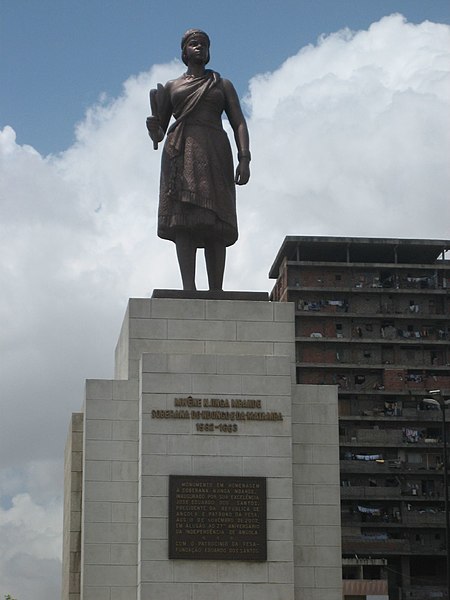 |
| The modern-day statue to Nzinga in Luanda |
After her death the Portuguese were able to seize control, and restore the shipping of slaves to Brazil.
Nzinga is honoured as a hero in modern Angola.
- Antonia Frazer. The Warrior Queens. London: Mandarin Books, New York: Anchor Books 1988: 238-46.
- Leslie Feinberg. Transgender Warriors: Making History from Joan of Arc to Rupaul. Beacon Press, 1996: 34.
- Jone Lewis. "Anna Nzinga". Women's History. http://womenshistory.about.com/od/medrenqueens/p/nzinga.htm.

Subscribe to: Post Comments (Atom)
Featured post
Moscow, 1926
In Nikolai Krementsov's Revolutionary Experiments: The Quest for Immortality in Bolshevik Science and Fiction , Oxford, 2013, we find on...
 Terjemahan
About Zagria and this site

- Essays on trans, intersex, cis and other persons and topics from a trans perspective.......All human life is here. ------------- I have a social science degree. I spent several years in the 70s doing Gay Lib counselling, and moved on to organizing trans groups. I was rejected by the Clarke Institute (now CAMH) in the mid 1980s, probably because I do not match either of their stereotypes, but was accepted by Russel Reid on our first meeting in late 1987, and had surgery from James Dalrymple some months later. I have mainly worked as an IT consultant. I have been with the same husband for 47 years.
Popular Posts
- Sometimes we get only a snapshot of a person, and never find out what happened to them later. Here are two trans woman surviving as per...
 Original version: October 2010 Walter Winston was born in Atlanta, Georgia. His family, like many other African Americans, moved north t...
 Giovanni Arrivoli (1975 - 2016) Post-transition Giovanna Arrivole was arrested with 17 others for drug dealing, and was released in 2012...
- Kimberly's story is told from two sources: Susanna Pena's history of TAO and Art Kleps' history of the early years of psychedel...
- John Coulter was a man of definite masculine appearance with good muscular development. At the age of twenty-one he was working as a man-s...
 William Muirhead-Allwood was educated at the Wellington independent school in Somerset, and was trained at the prestigious St Thomas’s ...
 While Stonewall was an iconic event for both the trans and the gay movements, the perspectives of the two movements are quite different. ...
 On the topics of, and around Stonewall, I have already published the following accounts Stonewall Inn and the Riots Three Centuries of Po...
- In the late 1920s the police in Garrus in Iranian Azerbaijan became aware of a young person with a non-standard gender. The person was re...
- Ashley qualified as a doctor, and married young. At age 25 he knew he wanted to be a woman, and the marriage ended in divorce. She had com...


Subscribe To

 Posts Comments
SOURCE https://zagria.blogspot.com/2013/09/nzinga-mbandi-1583-1663-queen.html#.XdjI05jRUbs
Queen Anna Nzinga Angola
Queen Anna Nzinga Angola

Queen Anna Nzinga (c. 1583 – December 17, 1663), also known as Ana de Sousa Nzinga Mbande, was a 17th-century queen (muchino a muhatu) of the Ndongo and Matamba Kingdoms of the Mbundu people in Angola.
Nzinga was born to King Kiluanji and Kangela in 1583. According to tradition, she was named Njinga because her umbilical cord was wrapped around her neck (the Kimbundu verb kujinga means to twist or turn). It was said to be an indication that the person who had this characteristic would be proud and haughty, and a wise woman told her mother that Nzinga would become queen one day. According to her recollections later in life, she was greatly favoured by her father, who allowed her to witness as he governed his kingdom, and who carried her with him to war. She also had a brother, Mbandi, and two sisters, Kifunji and Mukambu. She lived during a period when the Atlantic slave trade and the consolidation of power by the Portuguese in the region were growing rapidly.
In the 16th century, the Portuguese position in the slave trade was threatened by England and France. As a result, the Portuguese shifted their slave-trading activities to The Congo and South West Africa. Mistaking the title of the ruler, ngola, for the name of the country, the Portuguese called the land of the Mbundu people "Angola"—the name by which it is still known today.
Read More: http://en.wikipedia.org/wiki/Nzinga_of_Ndongo_and_Matamba


Langganan:
Komentar (Atom)
No comments:
Links to this post
Create a Link